
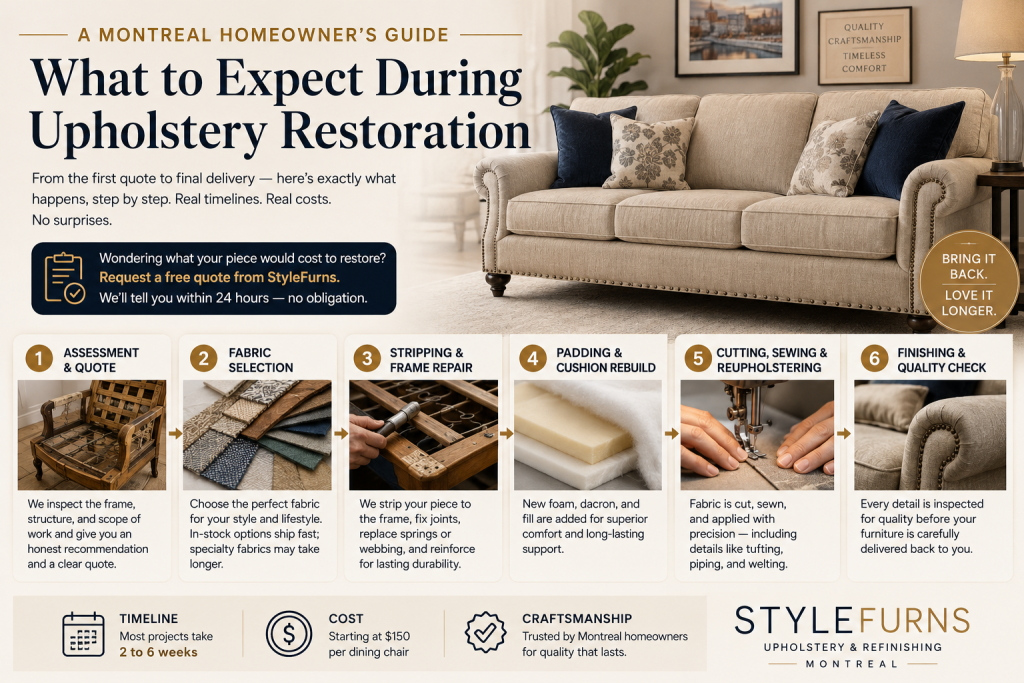
If you’ve got a couch, armchair, or dining set that’s lost its shape, its color, or its comfort, upholstery restoration can bring it back often for less than the cost of buying new, and without losing a piece you actually love. But most people book their first restoration with no idea what actually happens once the furniture leaves their living room.
Here’s exactly what to expect, step by step, from the first quote to the final delivery plus real timelines and costs, so there are no surprises.
Wondering what your piece would cost to restore? Request a free quote from StyleFurns and we’ll tell you within 24 hours no obligation.
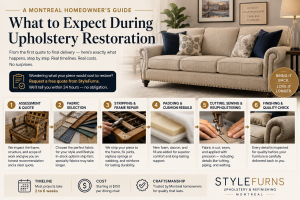
Step 1: Assessment and Quote
Every upholstery restoration project starts with an inspection, either in your home, in photos you send us, or in our Montreal workshop. We’re checking three things:
- The frame, is it solid hardwood, or particleboard that won’t hold up to a second life?
- The internal structure, springs, webbing, and padding condition
- The scope, full furniture reupholstery (new fabric, padding, and structural work) vs. a simpler repair or recover
This is also where we’re honest with you about whether restoration is worth it. A well-built frame is almost always worth restoring — that’s where the real value of the furniture lives. A cheap frame with structural damage often isn’t, and we’ll tell you that upfront rather than take the job anyway.
Step 2: Fabric Selection
Once you’ve decided to move forward, you’ll choose your fabric. This step often takes longer than people expect, and it’s usually the single biggest factor in your total timeline (more on that below).
Things worth knowing:
- In-stock fabrics ship fast and keep your project moving
- Specialty, imported, or performance fabrics can take several weeks to arrive before work even starts
- Durability matters as much as looks, for households with kids, pets, or heavy daily use, we’ll steer you toward performance or high-rub-count fabrics rather than fabrics that look best in a showroom
Step 3: Stripping and Frame Repair
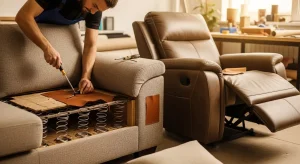
Your furniture is stripped down to the bare frame. This is the point where hidden problems, a cracked joint, sagging springs, worn-out webbing, actually surface, even on pieces that looked fine from the outside. A reputable shop should:
- Reinforce or repair joints and frame repair issues before anything else happens
- Replace broken springs or sagging webbing, not just cover over them
- Confirm any additional cost with you before proceeding, not after the invoice
This is the step that separates real restoration from a quick reupholster job, and it’s exactly why a piece with a well-built frame is worth the investment.
Step 4: Padding and Cushion Rebuild
Old foam compresses, flattens, and stops supporting you the way it used to. During restoration, we typically replace:
- Seat and back cushion foam
- Dacron wrap for a smooth, upholstered finish
- Any horsehair or natural fill on antique pieces, matched to the original where appropriate
This step is why a restored sofa doesn’t just look new, it actually sits like new again.
Step 5: Cutting, Sewing, and Reupholstering
This is the most labor-intensive stage, and where custom upholstery work really shows. Your fabric is measured, cut, and sewn to match the piece’s exact contours, then applied to the frame with attention to pattern matching, seam placement, and tension. Details like tufting, piping, and welting are done at this stage and add both time and cost.
Step 6: Finishing and Quality Check
Before your furniture comes back to you, it goes through a final check: seams, tension, cushion fit, and any hardware (legs, nailheads, zippers) are inspected and adjusted. Any pickup or delivery in the Montreal area is scheduled at this point.
How Long Does Upholstery Restoration Actually Take?
Most furniture reupholstery projects take 2 to 6 weeks from drop-off to completion, though the real range depends heavily on two things:
| Project type | Typical timeline |
|---|---|
| Single dining chair or ottoman | 1–2 weeks |
| Armchair or accent chair | 2–3 weeks |
| Standard sofa or loveseat | 3–4 weeks |
| Large sectional or custom rebuild | 4–8 weeks |
The biggest variable isn’t the labor — it’s fabric lead time. In-stock fabric can ship in days; specialty or imported fabric can add 4–6 weeks before we even start. If your timeline matters (a move, an event, a renovation deadline), tell your upholsterer upfront and choose fabric accordingly.
What Does Upholstery Restoration Cost?
Costs vary by piece size, fabric, and how much structural work is needed, but here’s a realistic starting range in Canadian dollars:
| Piece | Typical cost range |
|---|---|
| Dining chair | $150 – $400 each |
| Accent or armchair | $400 – $900 |
| Loveseat | $600 – $1,600 |
| Standard sofa | $900 – $2,000 |
| Sectional | $2,000 – $4,000+ |
Structural repairs (springs, webbing, frame joints) typically add $150–$500 on top of the base cost, and fabric itself usually runs $30–$70 per yard depending on quality. Antique pieces, tufted backs, and pattern-matched fabric all push costs toward the higher end of these ranges.
The honest comparison to make isn’t “restoration vs. nothing” it’s restoration vs. buying new. For a well-built frame or a piece with sentimental value, restoration is almost always the better long-term investment, because you’re paying for craftsmanship and materials, not a new frame you don’t need.
Get a firm number, not a guess. Book a free assessment and we’ll give you an exact quote based on your actual piece not a generic estimate.
When Restoration Makes Sense (and When It Doesn’t)
We’d rather tell you not to restore a piece than take a job that won’t hold up. Restoration is worth it when:
- The frame is solid hardwood and structurally sound
- The piece is a good fit for your space and you’re happy with the shape
- It’s an antique, heirloom, or high-quality piece that isn’t sold anymore
- You want a fully custom fabric and finish that off-the-shelf furniture can’t match
It’s usually not worth it when the frame is particleboard or already failing, or when the furniture holds no sentimental or design value and a comparable new piece would cost less than the restoration itself. A good upholsterer will tell you this before you pay for a quote, not after.
How to Prepare Your Furniture for Restoration
- Take photos of the piece from multiple angles before it leaves your home
- Note any specific issues (squeaks, sagging, tears) so nothing gets missed
- Decide roughly how you want to use the room going forward, it affects the fabric recommendation
- Ask your upholsterer for a written quote that separates labor, fabric, and any structural repair costs
Frequently Asked Questions
Is upholstery restoration cheaper than buying new furniture?
Often, yes especially for well-built or antique pieces where you’re paying for materials and labor rather than a brand-new frame. For lower-quality furniture with structural damage, buying new can sometimes work out cheaper.
Can any piece of furniture be restored?
Most can, as long as the frame is structurally sound. Furniture with rotted, cracked, or particleboard frames usually isn’t a good candidate for full restoration.
Do I need to supply my own fabric?
No, most upholsterers, including StyleFurns, offer in-house fabric selection. You’re welcome to supply your own fabric as well, though extra handling fees may apply.
How do I know if my furniture is worth restoring?
Check the frame first. If it’s solid wood and free of major structural damage, it’s almost always worth restoring. A quick in-home or photo assessment will confirm this before you commit to anything.
Does upholstery restoration include cleaning or just re-covering?
A full restoration typically includes frame repair, padding replacement, and new fabric, not just a surface recover. If you only need cleaning or minor repair, ask your upholsterer about a lighter-scope option, which costs less.
Ready to Restore Your Furniture?
If you’re in Montreal and have a piece that deserves a second life, we can walk you through exactly what your restoration will involve, with a straight answer on cost, timeline, and whether it’s worth doing at all. Book your upholstery restoration.